

Every school has a history behind it. Most of us think we know LDHS’s history, but some students are left with questions about their school. When was it built? What was it like attending LDHS when the school first opened? Were the buildings we have right now always here? Who decided to design a building with octagonal pods? Basic questions can sometimes remain unanswered, but Sword & Shield is here to clear up any confusion about LDHS’s past.
In District 55, the first district-wide high school was established 54 years ago, which enabled desegregation and consolidated all five of the District 55 high schools. LDHS was the first high school built to support the growing student population in Laurens County and to serve as a unified school. In 1969, the Board of Trustees initiated a plan to build a new school that would serve all children, regardless of ability or race.
The cost of building the original LDHS structure (Main Building, Gym and Tech Building) was approximately $4.6 million for the 240,000-square-foot facility. Pretty costly, but worth it to support a larger population coming into Laurens. In fall 1972, the doors to LDHS finally opened, with the class of 1973 being the first graduating class, while also, unfortunately, only being at the new school for a year. The school had yet to finish paving the parking lots, leaving them covered in mud. Construction was ongoing in the area around the campus, creating a semi-hazard for staff and students inside the classrooms (mainly the labs), and K.C. Hanna Stadium had not yet been built. The stadium was named after the former superintendent King Cegil Hanna, Sr., who led District 55 for 15 years. Leading up to his retirement, the District named the field in his honor.
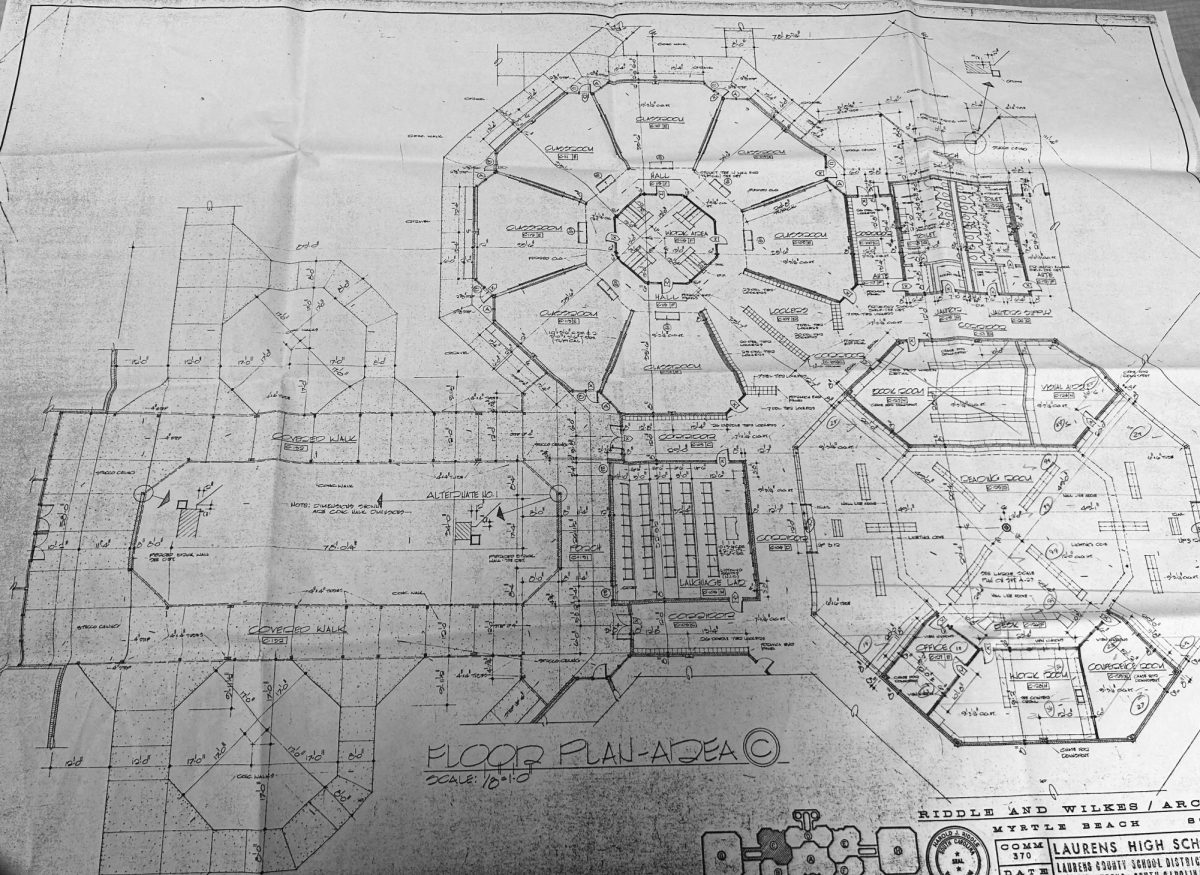
The architecture firm Riddle and Wilkes prepared plans and specifications of the layout, which would confuse the first-year students (and all those who have followed over the next 54 years) because of the way the pods were shaped. But what is a pod? N-, P- and R-Pods were originally groups of seven classrooms and an entrance hall that surrounded a central teacher workroom. Another unique feature of the pod classrooms is that they only had three walls, the cinderblock walls that still exist today. The interior hallway sides of the rooms were completely open, and the large wooden bookcases/storage units that are in most of the G, N, P and R classrooms stood in the openings and blocked the views into other rooms, but not the sounds coming from them. Neither the J- nor I-Pods included walls, but the supply cabinets in those classrooms helped them to feel a little more enclosed than the rooms in the other pods. LDHS constructed the interior pod walls in the mid-1990s. The sides of each classroom that faced the interior pod hallway had no walls, and students and teachers could see into other classrooms and hear what was happening in those rooms as well. For instance, students in English teacher Jamie Childress’ room, N-106, could have seen into N-104 and N-108, and they could have heard instruction or disruption in any of the other N-Pod classrooms, especially if the class were working quietly.
Both Childress, LDHS Class of ’86, and U.S. History teacher Kimberly Martin, ’01, believe that the lack of walls created a distraction for students.
When LDHS was first built, there was no L-Building, Aux Gym or A-Building. What students today know as the Tech Building was originally called the Y-Building; when the wing that today’s students recognize as the Y-Building was constructed on the East end of campus, the building on the West end of the school was named “Tech” because of the career and technology classes housed there, and the classrooms were labeled as “T” instead of “Y.” (The Gym, by the way, has always been the Z-Building.) Although the original building plans called for an A-Pod to be built on the North side of S-101, construction funding fell short and those classrooms were not built. Eventually, as the number of students grew, the school added portables to accommodate those students and their teachers.
“When I went to high school here, there was no L-Building, Aux Gym, Y-building or A-Building,” U.S. History teacher Kimberly Martin, ’01, said. “And we had tons of portables in the back, and the front parking lot, where the students park [now], was a field of grass. The science pods, J and I, didn’t have any walls; it was open, and classes could easily get distracted.”
But what is a portable? Portable classrooms, which were introduced to LDHS a few years after the school was built, were trailers that would be located behind the school, with 10 classrooms where the A-Building is now. The current nurses’office trailers were actually once the D portable classrooms. What we know today as A-Building and Y-Building were originally the locations of portables before the buildings were actually constructed. Slowly, the use of the portables started coming to an end over the course of the year, as LDHS started to construct new buildings, like A-Building and Y-Building, to accommodate the new students coming into the school year. Some of the portables would end up being removed or sold off, and some would end up staying, just like the nurses’ office and the other surrounding portables.
When LDHS was first being built, there were already high schools in the district: Ford, Hickory Tavern, Gray Court, Laurens (now Laurens Middle) and Sanders, which merged with Laurens for the 1971-1972 school year. As explained earlier, the rationale for constructing LDHS was to consolidate all District 55 high schools into one and to desegregate the district, starting with the elementary schools in the 1966-1967 school year and ending with the high school in 1972-1973. But why is there a “District” and a “55” in the name? The reason for including the words in the name of the new high school was to differentiate between it and the pre-existing Laurens High School and not to cause confusion between the similarly named schools. Throughout the construction and planning process of LDHS, what we know as Laurens Middle, formerly known as Laurens High School, would also earn a new name — Laurens Junior High School.
Building a new high school requires a community to come together and develop ideas, mascots, a name, school theme colors and an alma mater.
How did LDHS even get its alma mater? Heck, how did the people in charge come up with the idea to let a Raider become the face of the school? Choosing an alma mater and a mascot for a high school could be challenging, considering they function as a long-lasting representation of identity, unity, uniqueness and a face for the community. Especially the alma mater, for how important it is when matching a school’s environment to build a sense of community and to also serve as an official school song or anthem. The alma mater was introduced by a student, Tabby Hughey, ’72, who was the drum major in the Raider Band. Hughey was named to the McDonald’s All-American Band, being one of the two people to be selected in South Carolina during the summer of coming up with the idea of the alma mater. During the time Hughey was looking to create the alma mater, he went to Buist Farmer, the band director at the time, to check if there was an alma mater already, but Farmer had no idea what the alma mater would be. And so, the creation of the alma mater began.
“Tabby was chosen to be drum major, and he was also named to the McDonald’s All-American band, which they only selected two people from each state to be in while that was going on.” Former LDHS band director and assistant principal David Mauldin, ‘76, said. “That was done over the summer, and as I recall, Tabby went to Buist Farmer, the band director at the time, and said, with the new school, what’s going to be the alma mater? Buist said he had no idea. And Tabby said, do you mind if I write one? And he said sure. And from my perspective, it was just placed in front of us and said, This is the alma mater. Tabby wrote it, and everybody clapped, and we played it.”
Yet, how did LDHS decide on the raider as the mascot? Back before the school was built, the District decided to take votes and nominations on what the community would prefer the mascot to be, having a few choices between the Patriots, red, white, and blue. Or the Raiders, green and gold. There were other choices, but the Raiders ended up winning by community voting as the school mascot, now serving as the face of LDHS and with its rallying cry, “Go Raiders!” and “Once a Raider, Always a Raider.”
“The district took nominations, and they got it narrowed down to we had the choice between the Patriots and red, white, and blue, the Raiders, green and gold. And I can’t remember what the other options were; there were three options of colors and mascots, and I can’t remember what the third one was. But there was a vote, and the Raiders, green and gold, were elected,” David Mauldin said. “The school district wanted to make sure that we weren’t using any of the colors of the other high schools or the mascots of the previous high school. They wanted to be a clean start.”
When LDHS was being built, there was originally going to be an outdoor amphitheater, and there was also supposed to be a second story, a basement, beneath G-Pod that would have become the student lounge. But unfortunately, the funding for LDHS ran out, and the construction crew never got to finish the potential add-on, which would have been amazing for students to go to if they needed somewhere to relax or a nice area overall for a class to be held in. And not to forget to mention, the Raider baseball team ended up winning their first championship in the first year of LDHS being built, bringing the whole baseball community together, including the students and staff of LDHS. Once a Raider, Always a Raider!