

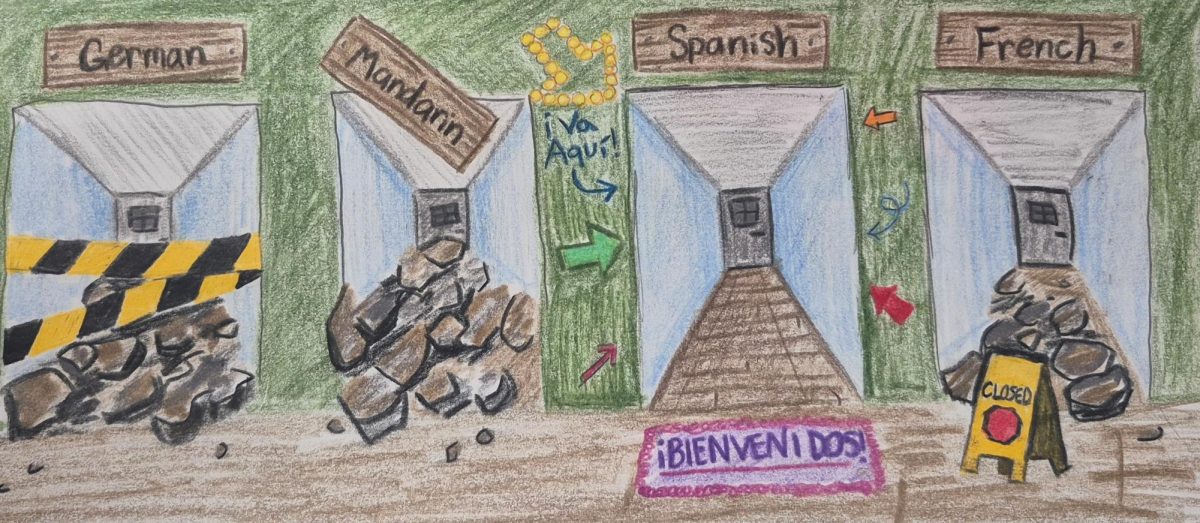
To graduate from LDHS and attend a 2-year college, students must have at least one credit in a foreign language. For a 4-year college, they will need two foreign language credits. Some universities, like Clemson, require more, but there is a downside: LDHS offers only one foreign language, and that is currently Spanish.
The last time LDHS saw a different language was the year COVID-19, unfortunately, hit, and the last language to be offered was Chinese, which was taught by Hengzhen Zhu, a teacher from China who worked here for two years. In the past, LDHS has also offered French and German classes, allowing students to embrace a different culture and environment, while also learning a whole new language. From the ground up of the concrete walls that students walk through at LDHS today, French was the first language to be taught as a foreign language credit from 1972 to 2006, and then German, which was taught by Harold Lingon from 1993 to 2011.
Offering different languages could be very beneficial, considering that maybe somebody would think, “Hey, I’d like to learn Spanish and a different language at the same time,” but they can’t. Why? Spanish is the only language currently offered at LDHS. Of course, people can always learn different languages on their own time… but where is the fun in that? Some people desire the feeling of knowing that their transcript for college is outstanding and stands out from other applicants, like certain classes they took, grades, sports, clubs, or even extracurricular activities. Having two or more semesters of foreign language classes, in addition to giving students valuable skills, can make the students stand out among other college applicants.
Or maybe there’s a student out there who is amazing at understanding and learning different languages, but their options are currently limited to the small choices of foreign languages being offered. Diving into the foreign language history of LDHS, the first two languages to be offered were French and German, both being common foreign languages that are taught in public schools in South Carolina. Unfortunately, LDHS no longer offers French and German after Harold Ligon, ‘11, who taught German and Chemistry, and Mandy Stallard, ’06, who taught French, retired. And then there was Chinese, where various teachers would come from a program called the Confucius Institute program with PC, and worked on a visa until their two years were up. Unfortunately, the program ended after COVID-19, and LDHS has not offered Chinese ever since that catastrophic event happened.
One of the good things about having different foreign languages is that students are allowed to embrace a different culture, atmosphere, and get a good feel for how to speak to a person who does not speak the same language as they do. Learning a new language can go a long way for anybody, considering that not everybody speaks the same language as the next person. Some workforces require employees to know another language, for instance, healthcare workers. Every individual patient who walks through the doors may not automatically know English and could be fluent in a different language.
“The world is a big place, and I think when you grow up in a small town, you don’t always realize what is out there,” former French teacher Mandy Stallard said. “And I think the best experience in my life was living in France [as an exchange student] and being able to travel to other countries and just seeing what else is out there. I think when you learn another language, you’re not just learning that language, you’re learning another culture.”
A fun fact about learning foreign languages is that some programs allow students to travel to the country where they are learning the language! For example, in the former German class taught at LDHS, students would be able to travel to Germany with a partner school every four or five years. Mr. Ligon’s class would travel to Belzik, BMW, and Helen, Georgia, which was a small German town up in the mountains. Another thing Mr. Ligon’s class would do is allow their partner school to visit South Carolina as well and be part of LDHS for two weeks. Allowing them to be actual students of LDHS, spend the summertime or breaks with Mr. Ligon’s class, and more.
“We had a partner school in Germany, and we traveled to Germany and took students for about five years,” Harold Ligon said. “For four or five years, a group of students went to Bezirke near Berlin in Germany, so we had a partner school there, so we could stay for two weeks with them and go to a high school in Germany, and also those students would come to us in the fall. We went in June of the year, and then they would come to us and stay two weeks in the fall, and live with families and go to schools here and take trips around South Carolina.”
Of course, there is nothing wrong with Spanish being the only foreign language offered at LDHS as an elective; it is just that students would enjoy having more than just Spanish as their foreign language options. Being able to speak Spanish is amazing after taking the class, but students would be thrilled to have the opportunity to speak not only Spanish but also another language to allow them to get a more diverse feel in the world. And yes, as said before, on how students could learn any language they want on their own time, that could be an issue because the reality of a student’s life often remains hidden outside of school doors. Being at school might be the only way they could learn a new language.
“As someone who has Spanish as their first language, and as somebody who is fluent in Spanish, I don’t find it very necessary for me to be in a Spanish one and Spanish two class, which is kinda the basics of Spanish,” Senior Nehemias Fernandez said. “It’s basically like somebody who has English as their first language going into an English class and them teaching you how to say hey how are you? Stuff that you already know, right? Not that it’s very relevant, but the classes are extremely easy for me, which is a good thing; it’s just that some people who might be an academic rigger would prefer a better, more challenging class. It could be Spanish, but just a more challenging Spanish class.”
Offering a more challenging Spanish class could address many issues for fluent Spanish-speaking students. It’d help by moving students beyond the average conversational level toward academic, professional, and formal language. Having a more challenging Spanish class could also improve the discussion of literature, history, and current events in the world. And not to forget to mention, a more challenging Spanish, like AP Spanish, could be extremely beneficial since Students would get a better understanding of a college-level curriculum. Exam preparations, the possibility of earning a college credit, and the challenging part, other than Honors Spanish, which focuses more on literature and grammar, with just a few extra steps to it. Adding an extra Spanish class that caters to AP could go a long way for the students of LDHS who strive for that academic achievement feeling.
Yet the question remains, how will LDHS manage to get a different foreign language offered for students? To teach a new language other than Spanish, LDHS would have to hire a teacher who is either certified or is in the process of getting certified, pass a state-mandated Praxis exam, which is an exam that teachers are required to take to measure their academic skills and subject-specific content knowledge of aspiring educators who look towards a state certification. The next step would be completing a teacher preparation program, applying for a certification at the South Carolina Department of Education, along with a background check for safety purposes, of course, and from there on out, the teacher would then apply to work at the school district they wish for in South Carolina. Still, in this case, the district they would apply for would be District 55. To offer another foreign language class, or even an AP Spanish class, there would need to be an available classroom that can accommodate 15 to 20 students, depending on how many sign up.
Although students may not get the foreign language classes they wish for, such as French, German, Mandarin, or even ASL, it would be excellent if AP Spanish were at least offered at LDHS, instead of a new foreign language class.